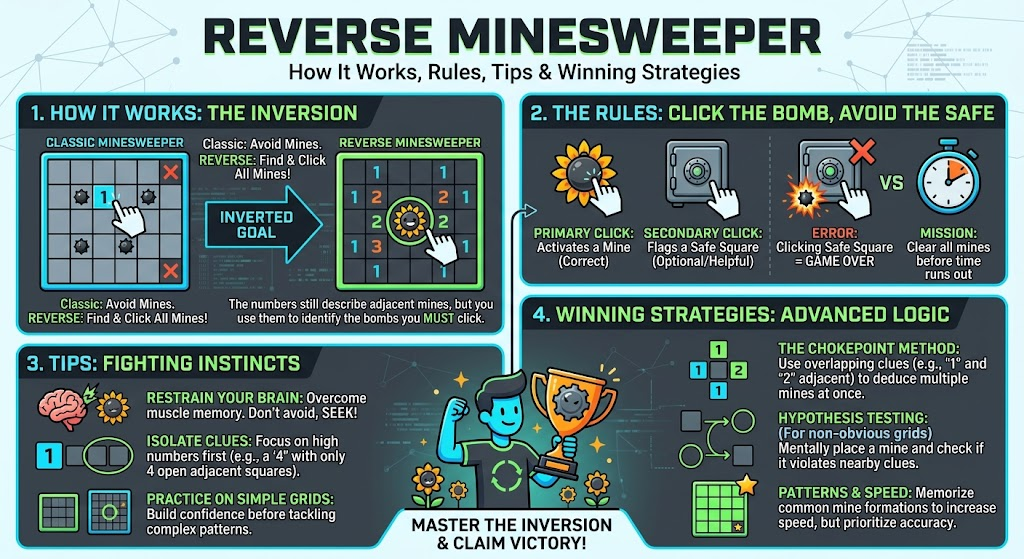
Reverse minesweeper is a fun twist on the classic Minesweeper puzzle. Instead of simply hunting for hidden mines, you approach the board from a different angle. The goal is to understand the clues, identify safe areas, and reason about where mines could exist. This change makes the familiar puzzle feel fresh and more challenging.
If you enjoy logic games, this version can be a great mental workout. You do not need fast reflexes or special gaming skills. You mainly need patience, careful thinking, and good observation. Each number gives you useful information about nearby squares. When several clues connect, they can reveal patterns that are easy to miss at first. This guide explains the basic idea, gameplay, strategies, mistakes, and useful solving habits. It also helps beginners understand why this puzzle can be so enjoyable.
What Is Reverse Minesweeper?
The basic idea behind reverse minesweeper is to change the normal way you think about Minesweeper. Traditional Minesweeper usually asks you to uncover safe squares while avoiding hidden mines. A reverse-style puzzle may change the goal, information, or direction of deduction. The exact rules can vary between versions, so checking the specific game rules is important.
What stays the same is the importance of logic. Numbers usually describe nearby mine activity or provide clues about surrounding cells. You must connect those clues and make sensible decisions. Some versions may give you a completed board and ask you to work backward. Others may ask you to place mines based on given information. This makes the term broader than one fixed game mode. The most important skill is learning how each clue limits your possible choices.
How Does Reverse Minesweeper Work?
Understanding reverse minesweeper becomes easier when you first understand clue relationships. A numbered square usually tells you something about the surrounding cells. For example, a number can show how many mines are touching that area. You can then compare nearby numbers to discover which cells must contain mines.
The reverse approach focuses more heavily on deduction. You may start with clues that already provide strong information. Then, you use those clues to solve neighboring areas. A useful method is to avoid looking at each square alone. Instead, examine groups of connected squares. Two nearby numbers often share several unknown cells. Their difference can reveal a mine or a safe position. This method turns the puzzle into a small logic problem rather than a guessing game.
Reverse Minesweeper Rules You Should Know
The rules can differ depending on the website, app, or game mode you use. However, most versions rely on a few simple ideas. You need to understand what each number means, which squares are unknown, and what counts as a correct solution. Some versions may use traditional mine placement rules, while others create a more unusual challenge.
Before starting reverse minesweeper, spend a moment learning the board’s instructions. Check whether you need to identify mines, mark safe cells, or reconstruct the hidden layout. Also check whether incorrect moves end the game. This small step can save you from making avoidable mistakes. Once the rules are clear, focus on the clues rather than rushing through the board. Good solving usually comes from careful reasoning.
Reverse Minesweeper vs. Classic Minesweeper
Classic Minesweeper and reverse minesweeper share the same logic roots, but their gameplay can feel very different. In classic Minesweeper, you normally open cells and use numbers to avoid mines. The main challenge is finding safe moves while gradually reducing uncertainty.
A reverse version may ask you to reason backward from the information provided. This can make the puzzle feel more like a logic exercise. Classic Minesweeper often rewards quick recognition of common patterns. Reverse gameplay can reward deeper comparison between clues. Neither style is automatically easier. Your experience will depend on the rules and board design. If you already understand classic Minesweeper, you have a useful foundation. You simply need to adjust your thinking and focus more strongly on relationships between clues.
A Simple Example for Beginners
Imagine three unknown cells sitting beside a clue showing the number two. That clue tells you that two of those nearby cells contain mines. Now imagine another clue beside the same area shows one. The second clue may share two of the unknown cells.
This small example shows why reverse minesweeper rewards comparison. You are not only asking, “What does this number mean?” You are also asking, “How does this number differ from the nearby clue?” If one clue requires two mines and another requires one, the difference can provide valuable information. With practice, these comparisons become much easier. Start with small patterns before attempting larger boards. Simple deductions often unlock several moves at once.
Best Strategy for Solving Reverse Minesweeper
A strong reverse minesweeper strategy begins with the easiest clues. Look for numbered cells surrounded by only a few unknown squares. These clues usually give you the clearest information. Mark conclusions as soon as you are confident about them, but do not mark guesses as facts.
Next, compare neighboring clues. Look for cells shared by two or more numbers. These overlapping areas are often the key to solving difficult sections. You should also revisit older clues after making a new deduction. One confirmed mine can change the meaning of several nearby numbers. This creates a chain reaction of useful information. The best players do not simply stare at the entire board. They break it into smaller sections and solve each section step by step.
Useful Patterns to Learn
Learning common patterns can make reverse minesweeper much easier. One important pattern happens when a clue has exactly the same number of unknown cells as its mine count. In that case, every unknown cell around that clue must be a mine. Another useful pattern occurs when the number of known mines already matches the clue. Remaining neighboring unknown cells must then be safe.
These ideas become powerful when clues overlap. Suppose one clue has three unknown cells and requires two mines. A nearby clue shares two of those cells but requires only one mine. The difference gives you a strong deduction. You can use this information to solve the remaining cell. Such patterns may seem difficult at first. After enough practice, your eyes will begin to recognize them naturally.
Common Mistakes Players Make
One of the biggest mistakes in reverse minesweeper is guessing too early. A player may see two possible choices and select one without enough evidence. That can ruin an otherwise solvable board. Instead, search for another clue that connects to the uncertain area.
Another common mistake is forgetting previous information. Players sometimes identify a mine but fail to update nearby clues. Every confirmed square changes the information around it. You should also avoid marking cells casually. A wrong mark can create confusion later. Finally, do not rush because the board looks easy. Even simple layouts can contain tricky relationships. Careful solving is usually more reliable than fast clicking. When stuck, step back and review the surrounding clues from a fresh perspective.
How to Improve Your Logical Thinking
Playing reverse minesweeper can encourage several useful thinking habits. You learn to compare information, test possibilities, and eliminate options. These skills are useful beyond puzzle games. They can also help with planning, problem solving, and careful decision-making.
Try explaining each move to yourself. Instead of saying, “This looks safe,” say why it is safe. For example, you might know that a nearby clue already has all required mines identified. Therefore, the remaining cells must be safe. This simple habit improves accuracy. You can also practice without worrying about speed. Speed often develops naturally after you understand the patterns. Focus first on making correct deductions. Confidence and faster solving usually follow with experience.
Tips for Beginners
If you are new to reverse minesweeper, begin with smaller boards. Smaller layouts make it easier to understand how clues interact. Avoid jumping straight into the hardest available level. Your first goal should be learning the logic rather than achieving a fast completion time.
Keep your attention on confirmed information. Separate facts from possibilities in your mind. If you are unsure about a square, treat it as unknown. Do not mentally turn a possibility into a fact. It also helps to scan the board systematically. Move from one section to another instead of clicking randomly. When no move seems obvious, compare two nearby clues. Their shared cells may contain the missing answer.
Advanced Reverse Minesweeper Techniques
Once basic patterns become comfortable, reverse minesweeper can support deeper deduction. One useful technique is called subset reasoning. This means comparing one group of unknown cells with another group. If one group is contained inside another, the difference can reveal additional information.
For example, imagine one clue tells you that two mines exist among three cells. Another clue tells you that one mine exists among those same three cells plus one extra cell. The difference may help identify the extra cell’s status. This type of reasoning can feel difficult initially. However, it follows a simple principle: compare what you know, then remove information that both clues share. Practice this method slowly. It can become very powerful on complex boards.
Is Reverse Minesweeper Based on Luck?
Good puzzle design should give you enough information to make meaningful deductions, but not every situation will feel obvious. Some Minesweeper-style games can include positions where guessing is unavoidable. That depends on the board generation system and the specific rules.
The best approach is to delay guessing for as long as possible. Search every connected clue before taking a risk. You may discover information that was hidden in another section. If a guess becomes necessary, consider which choice has better odds based on the available clues. Still, remember that probability is different from certainty. Strong players know the difference. They use logic whenever possible and accept uncertainty only when the game leaves no safer option.
How to Practice More Effectively
The easiest way to improve at reverse minesweeper is to practice with purpose. Do not play dozens of boards while repeating the same mistakes. Instead, focus on one skill during each session. You might spend one session learning basic clue patterns. Another session can focus on overlapping numbers and subset deductions.
After each difficult board, think about where you became stuck. Did you miss a simple pattern? Did you assume a square was safe without proof? Did you forget to update nearby clues? Answering these questions can improve your future games. You can also replay easier boards and try to solve them with fewer uncertain moves. Progress comes from understanding your decisions, not simply from completing more boards.
Why People Enjoy This Puzzle Style
The appeal of reverse minesweeper comes from its combination of simplicity and depth. The rules can be easy to understand, but solving a difficult board can require serious concentration. Each clue feels like a small piece of a larger puzzle.
There is also a satisfying moment when several deductions suddenly connect. A single confirmed cell can reveal the status of nearby cells. That can lead to another deduction and then another. The board slowly becomes understandable. This feeling makes logic puzzles rewarding. You do not need complicated graphics or a large story. The challenge itself provides the entertainment. Players who enjoy Sudoku, logic grids, number puzzles, and classic Minesweeper may especially enjoy this style.
Reverse Minesweeper for Kids and Families
Reverse minesweeper can be suitable for family puzzle sessions when the rules are simple and the board is age appropriate. Younger players can start with small layouts and basic clue relationships. Adults can help by asking questions rather than giving answers.
For example, instead of saying which cell contains a mine, ask how many mines the nearby number needs. Then ask how many possible cells remain. This encourages children to explain their reasoning. It turns gameplay into a learning activity without making it feel like homework. Parents should choose games with suitable content and controls. The best puzzle experience should be challenging but not frustrating. A little guidance can help beginners build confidence.
Quick Facts and Game Detail Table
The following table gives a simple overview for readers who want the key information quickly. Because different versions can use different rules, always check the instructions of the specific game you are playing. The core idea remains logical deduction, clue reading, and careful elimination.
| Detail | Information |
| Game type | Logic and puzzle game |
| Main skill | Deductive reasoning |
| Core challenge | Understanding clues and unknown cells |
| Difficulty | Easy to very challenging |
| Best for | Puzzle and strategy fans |
| Main learning skill | Logical thinking |
| Typical gameplay | Analyze, compare, mark, and solve |
| Speed required | Usually low |
| Luck involved | Depends on the specific version |
| Beginner friendly | Yes, with simple boards |
| Advanced skill | Pattern and subset reasoning |
| Similar game | Classic Minesweeper |
| Recommended approach | Solve from certain clues first |
| Main goal | Follow the rules and correctly solve the board |
Frequently Asked Questions
1. What is reverse minesweeper?
Reverse minesweeper is a Minesweeper-style puzzle that changes the usual solving approach. Instead of simply opening safe cells, you may need to work backward from clues or identify hidden mine positions. Rules differ between versions, so the exact objective depends on the game. The main skill remains logical deduction. Players study numbers, compare nearby cells, and eliminate impossible choices. This makes the game useful for people who enjoy number puzzles and strategy challenges.
2. Is reverse minesweeper harder than regular Minesweeper?
It can feel harder because the reasoning style is different. Classic Minesweeper teaches you to uncover safe cells while avoiding mines. A reverse-style version may require more direct deduction from existing information. However, difficulty depends on the board and rules. Beginners may find it confusing at first, but the basic ideas become easier with practice. Start with small boards and learn common patterns before attempting complicated layouts.
3. Can beginners play reverse minesweeper?
Yes, beginners can learn it with simple boards. Start by understanding what each number means. Then look for clues that have only a few unknown cells around them. Avoid guessing whenever possible. Work through one small section at a time. Once you understand basic deductions, move to larger boards. Practice is more useful when you review your mistakes and learn why a particular move was correct.
4. Does reverse minesweeper require fast reactions?
No, this type of puzzle mainly rewards careful thinking. You usually do not need quick reflexes or complicated controls. Taking extra time can actually help you avoid mistakes. Focus on reading the clues correctly and comparing connected cells. If your version has a timer, you can work on speed after learning the basics. Accuracy should come first because fast mistakes rarely help you finish a difficult puzzle.
5. What is the best reverse minesweeper strategy?
Start with clues that provide the most certain information. Mark cells only when the evidence supports your decision. Then compare neighboring clues and study their shared unknown cells. Revisit nearby numbers after every important deduction. If you become stuck, search the rest of the board for another certain move. Avoid guessing until you have exhausted the logical options. This approach keeps the solving process organized and reduces unnecessary mistakes.
6. Can playing reverse minesweeper improve logical thinking?
Logic puzzles can provide useful practice with comparison, elimination, and structured reasoning. Reverse minesweeper encourages players to examine evidence before making decisions. It also teaches you to separate facts from possibilities. These are valuable habits for many everyday problems. However, it should be viewed as a fun mental exercise rather than a guaranteed way to improve intelligence. The main benefit comes from active thinking and learning from each puzzle.
Conclusion
Reverse minesweeper gives the classic mine puzzle a fresh logical challenge. Its biggest strength is the way simple clues can create complex deductions. You do not need advanced gaming skills to begin. You only need patience, attention, and a willingness to test your ideas.
Start with small boards and focus on certainty. Learn basic patterns before using advanced techniques. When you get stuck, compare nearby clues instead of guessing immediately. With regular practice, difficult layouts can become easier to understand. The most rewarding part is watching separate clues connect into one clear solution. If you enjoy logic games, give this puzzle style a try. You may discover a new favorite way to challenge your mind.